Wien.
This one is real — and it’s where Rustichello began. I had two long layovers in Vienna, one on the way to London and one on the way back, and I planned each one to the hour to catch as much of the city’s magic as a stopover allows. It worked so well that I turned the improvised planning-and-remembering rig behind it into a harness I could use again. A month later I ran it in full for New York — and that was the moment I knew I had to share it. — Fitz
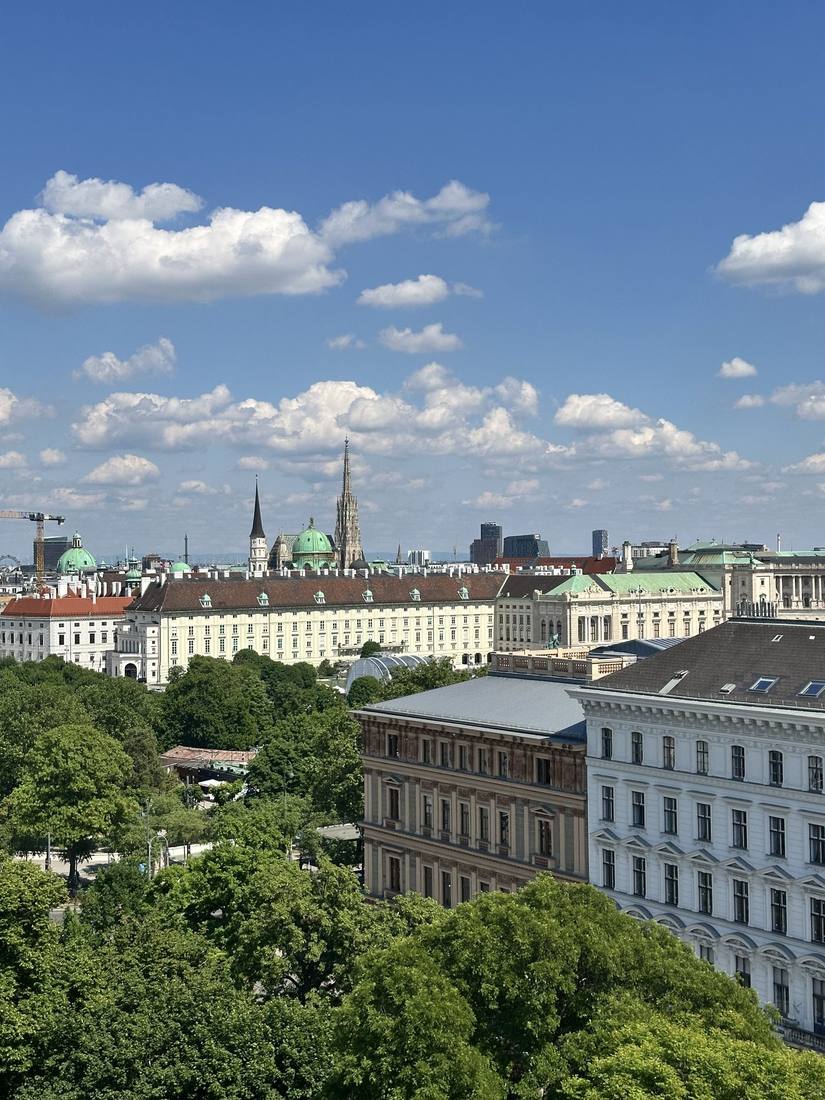
At a Glance
Two layovers, three weeks apart. From Stephansdom's first stones in the twelfth century to a titanium cantilever finished in 2003 — almost nine hundred years of European architecture in one walking distance.
Part I · The First Day
The Taster
Six hours in Vienna between two flights. Just enough to taste the city without trying to inhale it. Coffee on the Ring at first light, an hour in the Stadtpark, four churches stumbled into on a wander through the first district, and a final drink at a bar that fits inside 27 square metres and has been famous for over a hundred years.
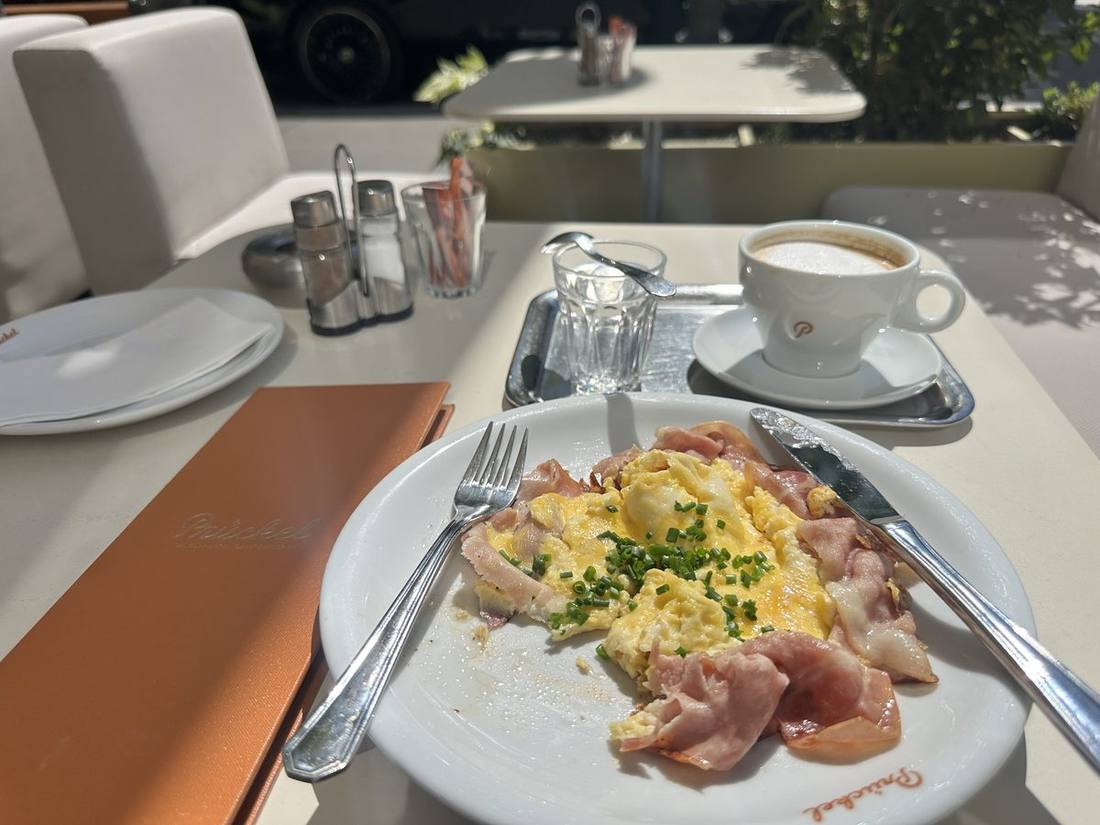
Café Prückel
Settling into Prückel just after it opens. The Ring's old Kaffeehaus has the same banquettes since 1955, the same Melange in the same Prückel cup. Eierspeise mit Schinken — eggs scrambled with Austrian ham, chives sprinkled on top — and watching the Number 2 tram glide past every few minutes. There's a particular morning hush in Vienna where the trams move but nobody's rushing yet.
Stadtpark
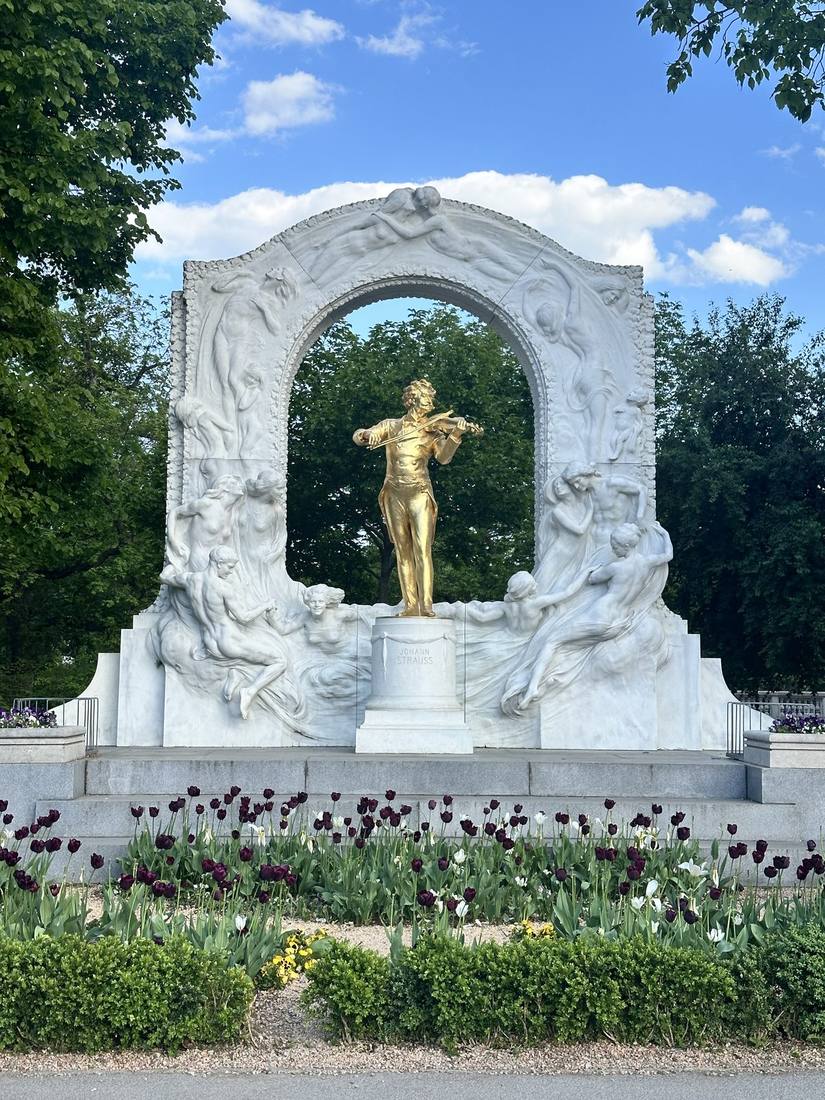
Walking through the Stadtpark to find the Strauss monument. Gilded bronze of Johann Strauss II, violin under the chin, framed by a white marble arch of Art Nouveau figures dancing around him. Vienna's most photographed statue — and you understand why the second you turn the corner. Dark tulip beds at the base, April sky, exactly the right light.
Franziskanerkirche
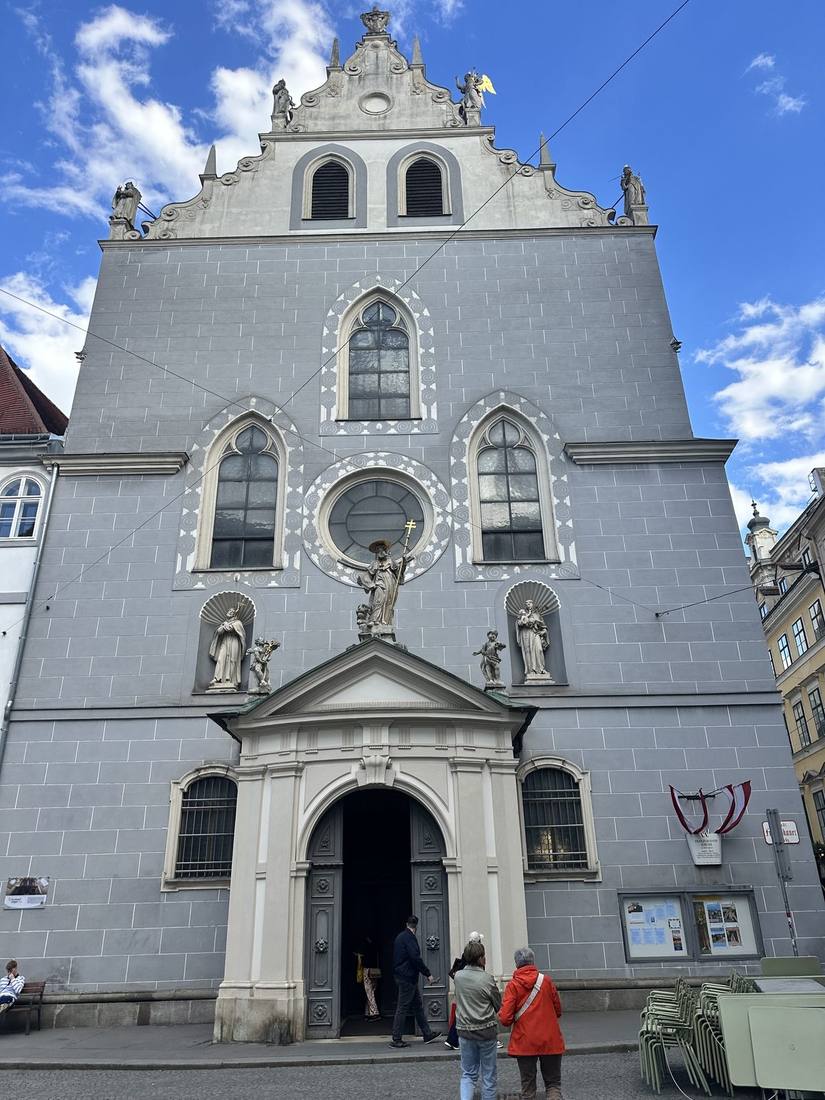
Wandering off the Ring into the back streets and finding Franziskanerkirche. The façade is the wrong colour for Vienna — a soft slate grey — with pointed Gothic windows below a curling Renaissance gable. Three styles, one wall.
The Franciscans have been on this corner since 1224, 802 years before this morning. The current building is from 1603; inside, Andrea Pozzo’s high altar of 1707 pulls its own trick — real columns dissolving into painted perspective partway up.
Jesuitenkirche
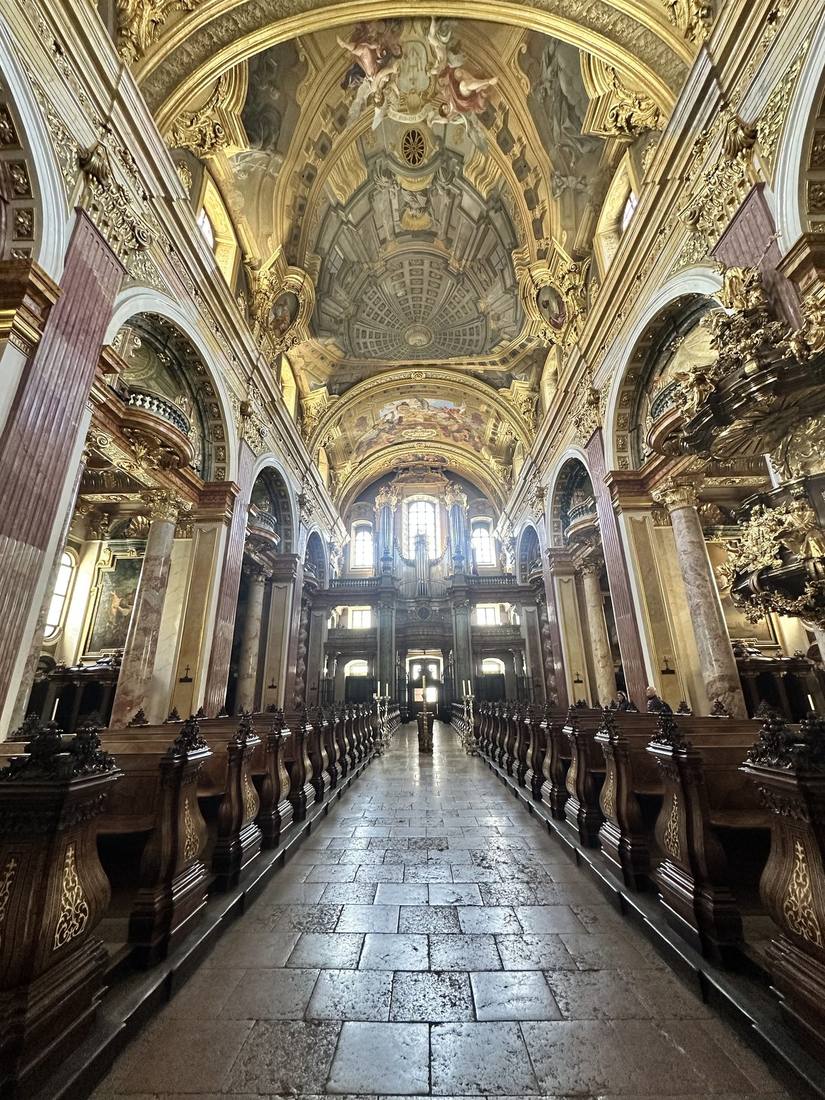
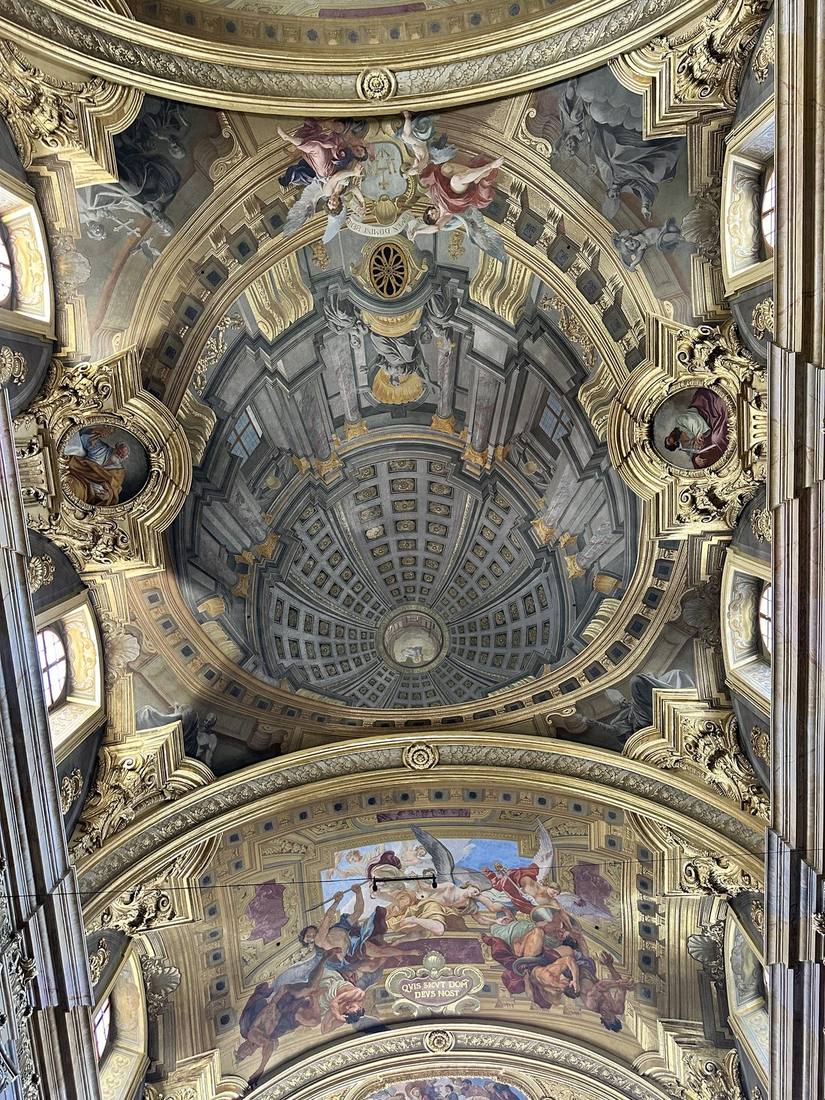
A few lanes north, the Jesuitenkirche — a sober front on a quiet university square hiding the most theatrical interior in the district. Pozzo again: between 1703 and 1705 he rebuilt the inside as pure illusion. The dome above the nave isn’t real — it’s painted flat onto the ceiling. The perspective only resolves correctly from one spot on the floor. Stand on the mark, the dome rises above you. Step left, and it collapses back into paint.
Dominikanerkirche
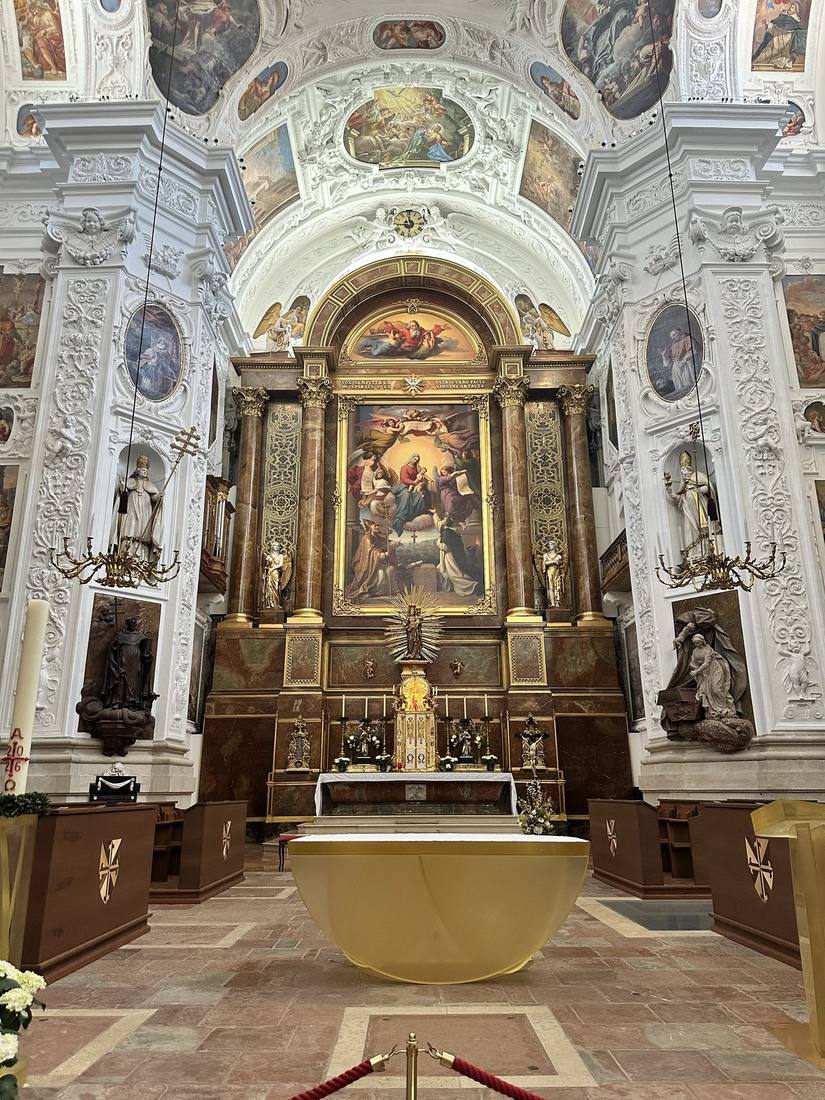
Two hundred metres further on, walking into Dominikanerkirche — the Dominicans on their site since 1226, almost the same as the Franciscans. The interior here is the textbook of Vienna baroque: white stucco that looks whipped onto the walls, brown marble columns, a single enormous altar painting of the Virgin and saints. A walnut confessional like a piece of cabinet-making sits in the side aisle, a small gold cross on its dome.
Stephansdom
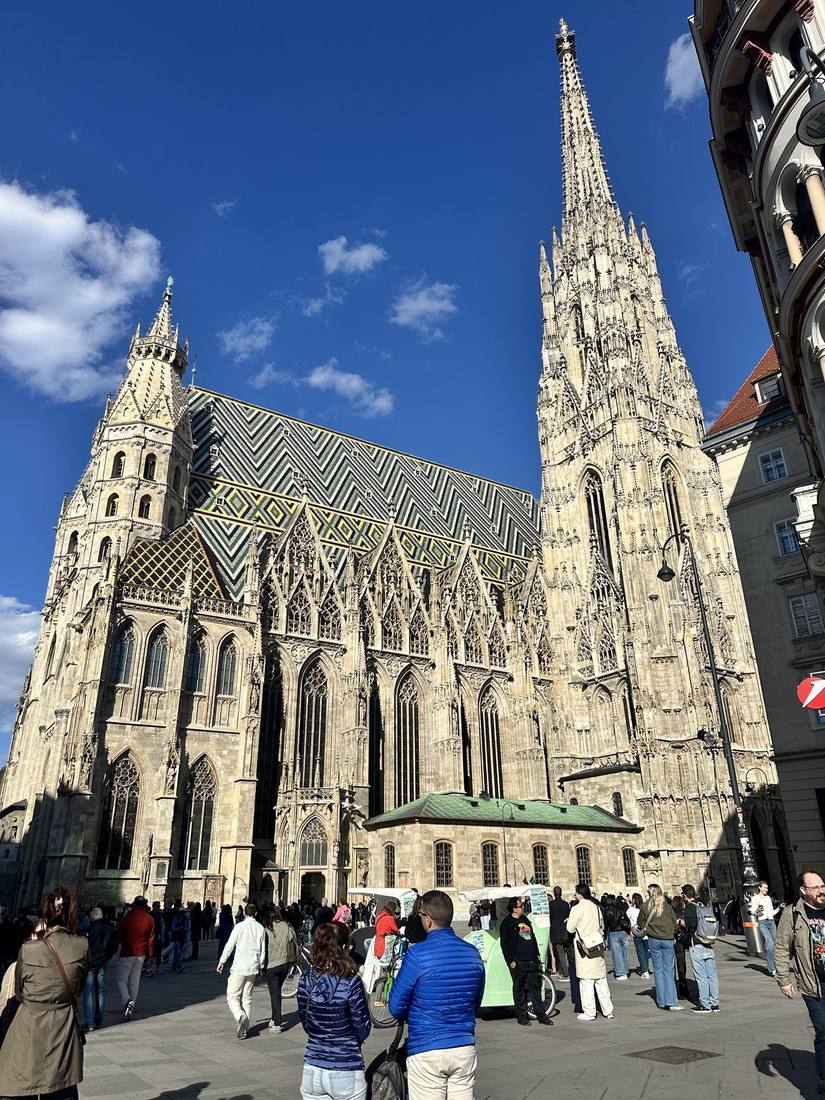
Then through the lanes to Stephansdom. You don't expect it until it's on top of you — the cathedral has been growing on this spot since 1147, and the south spire (the Steffl) rises 137 metres in carved limestone. The roof is tiled in 230,000 glazed chevrons that form the Habsburg double eagle when seen from above.
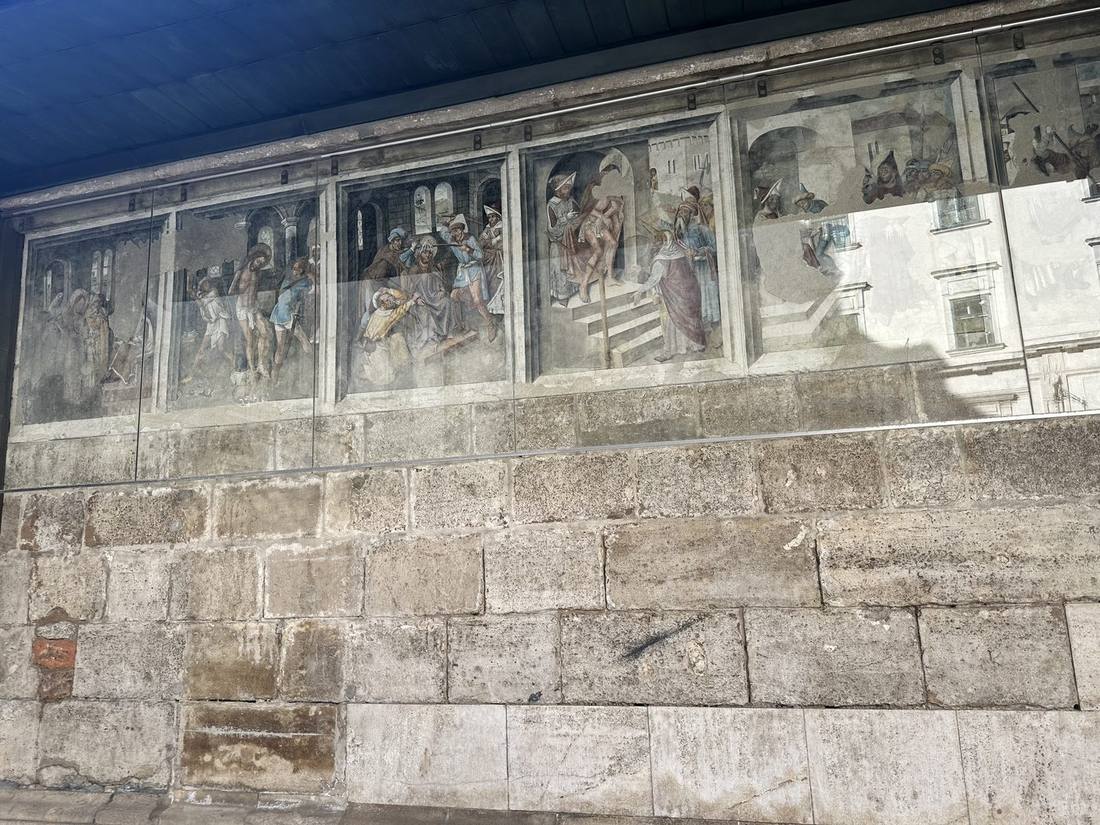
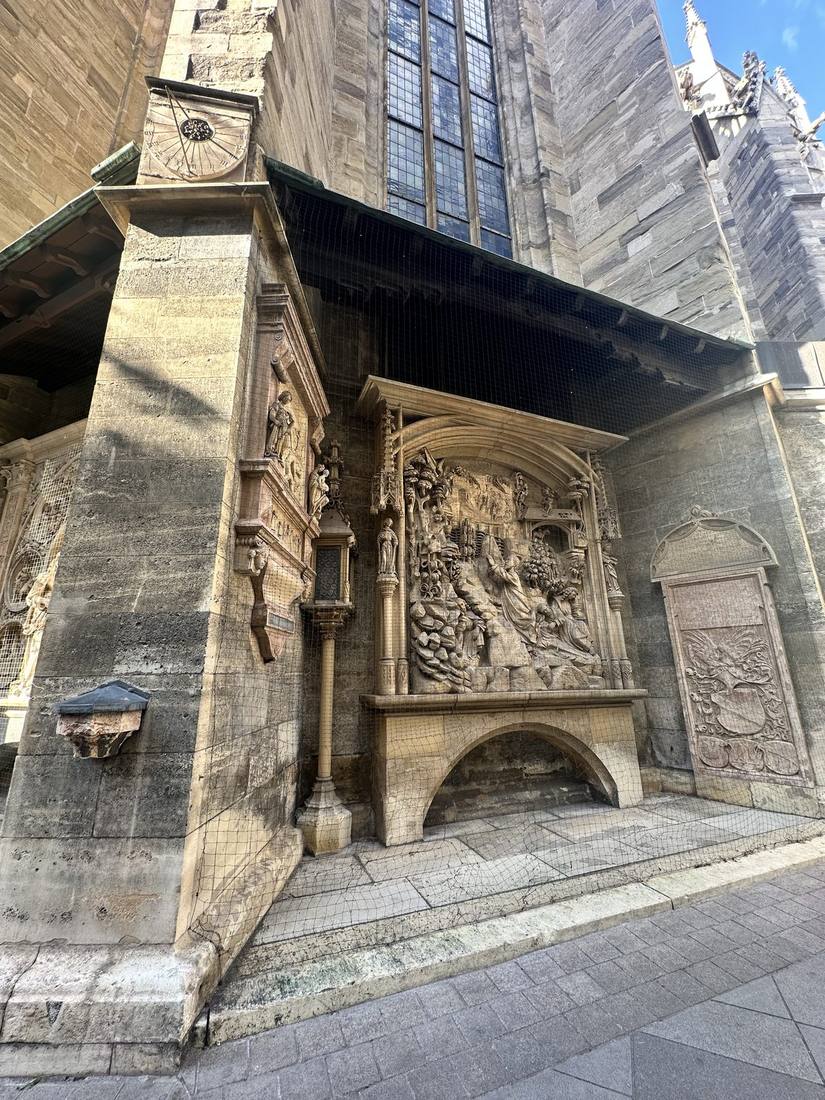
Walking the perimeter takes twenty minutes. On the south wall behind glass: a Passion fresco cycle from the 1400s, still in colour. Tucked under a buttress: the Zahnwehherrgott, the Toothache God — a stone Christ figure whose anguished face used to draw pilgrims praying for relief from dental pain.
Loos American Bar
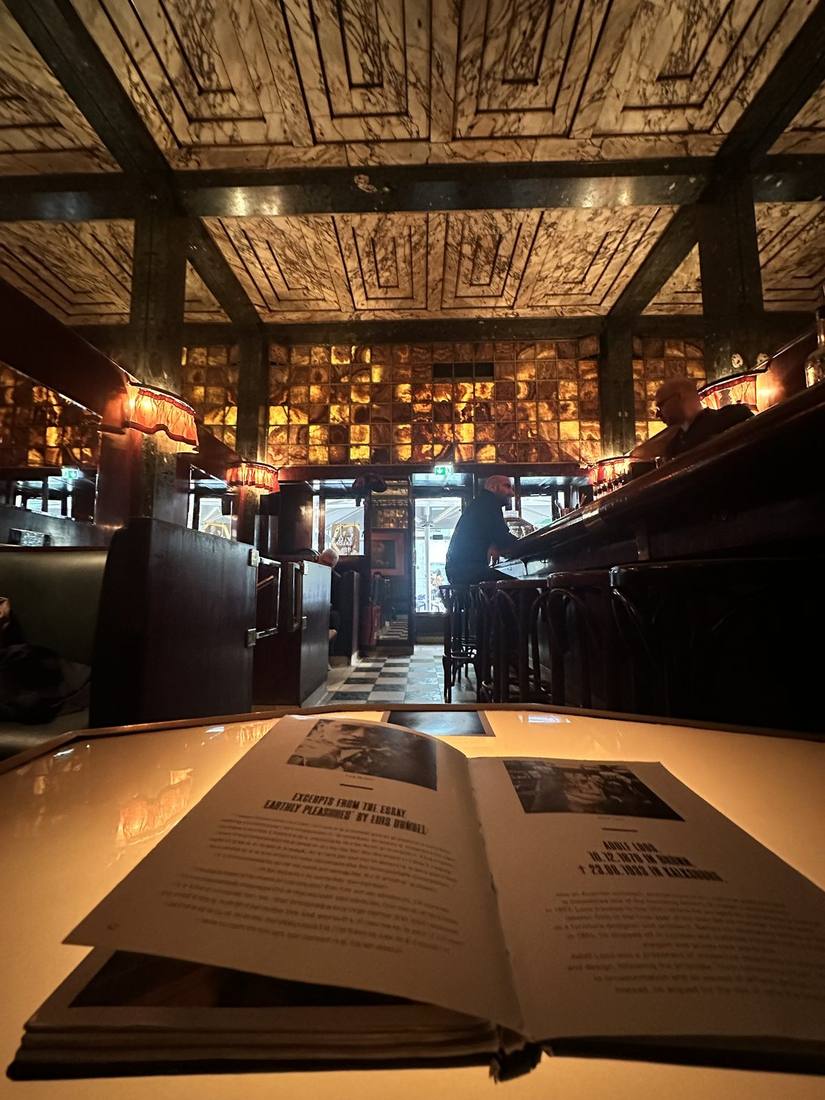
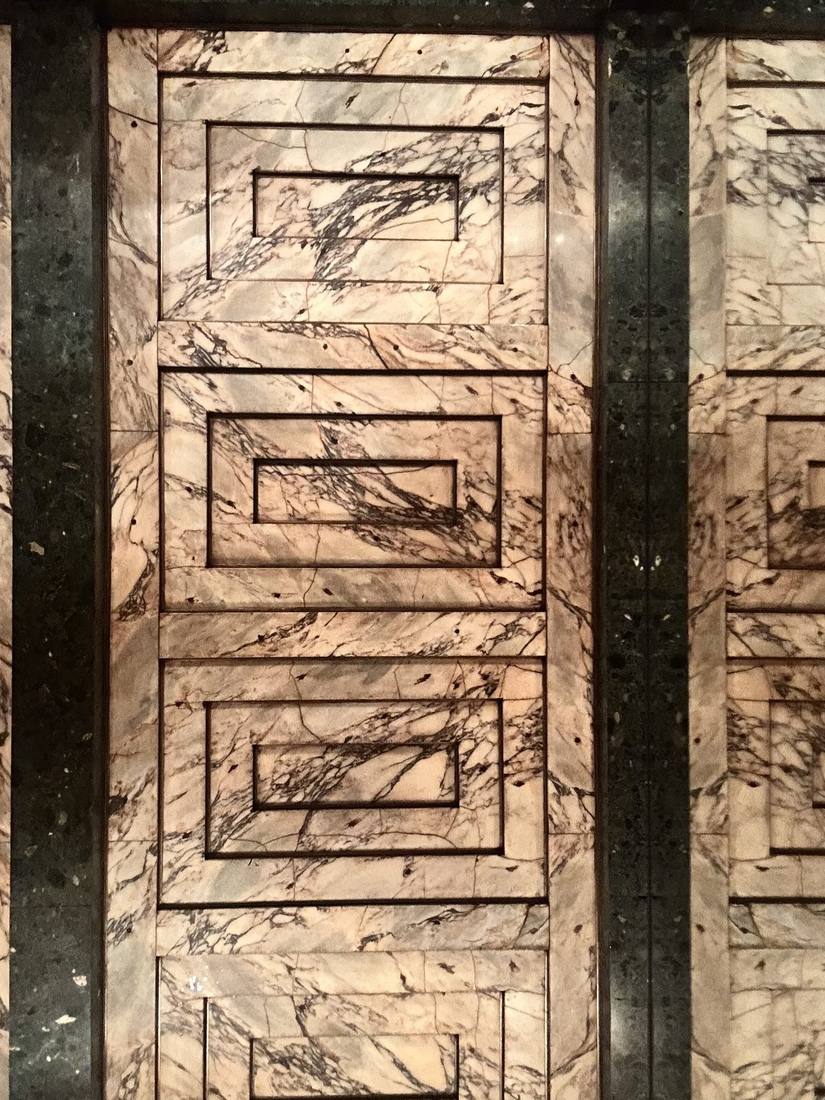
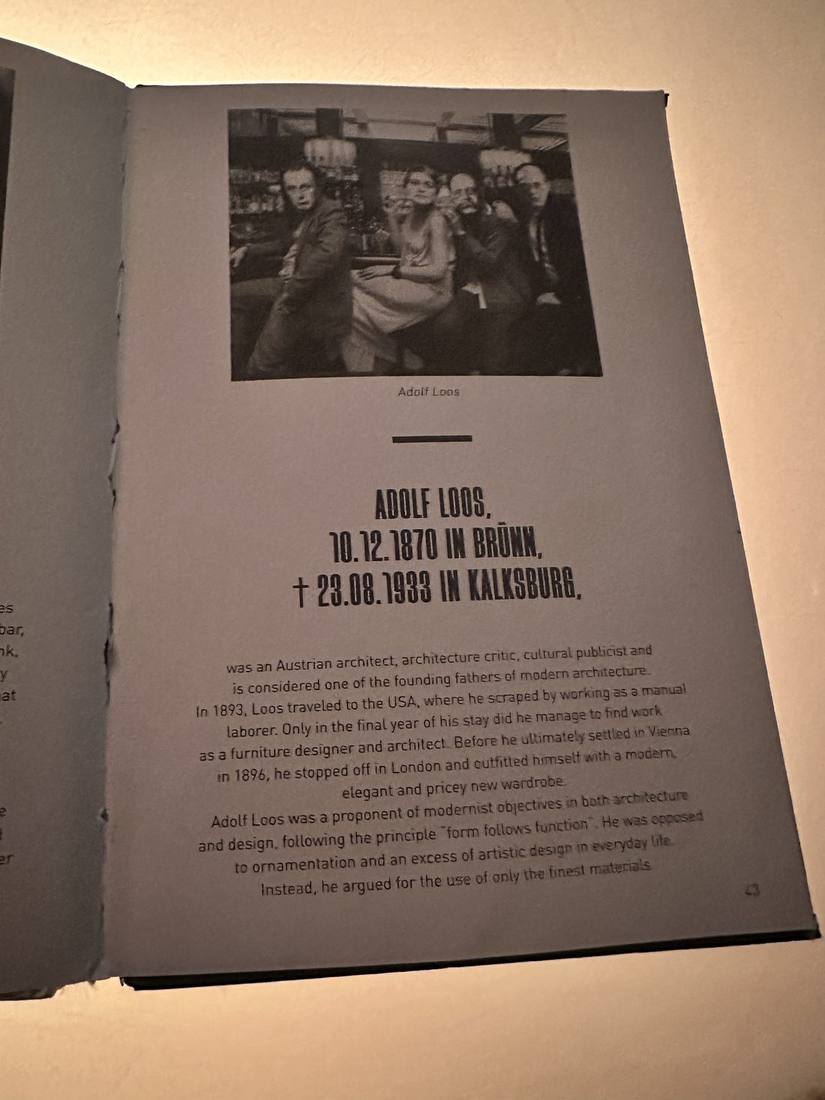
Then to Loos. Easy to miss — the entrance is a thin slot off a side alley off Kärntner Straße. Inside: 27 square metres, mahogany and brass and onyx-glass, designed by Adolf Loos in 1908 as a protest against ornament. Mirrors set into the upper walls expand the room to infinity — the eye reads it as a much bigger bar than it actually is.
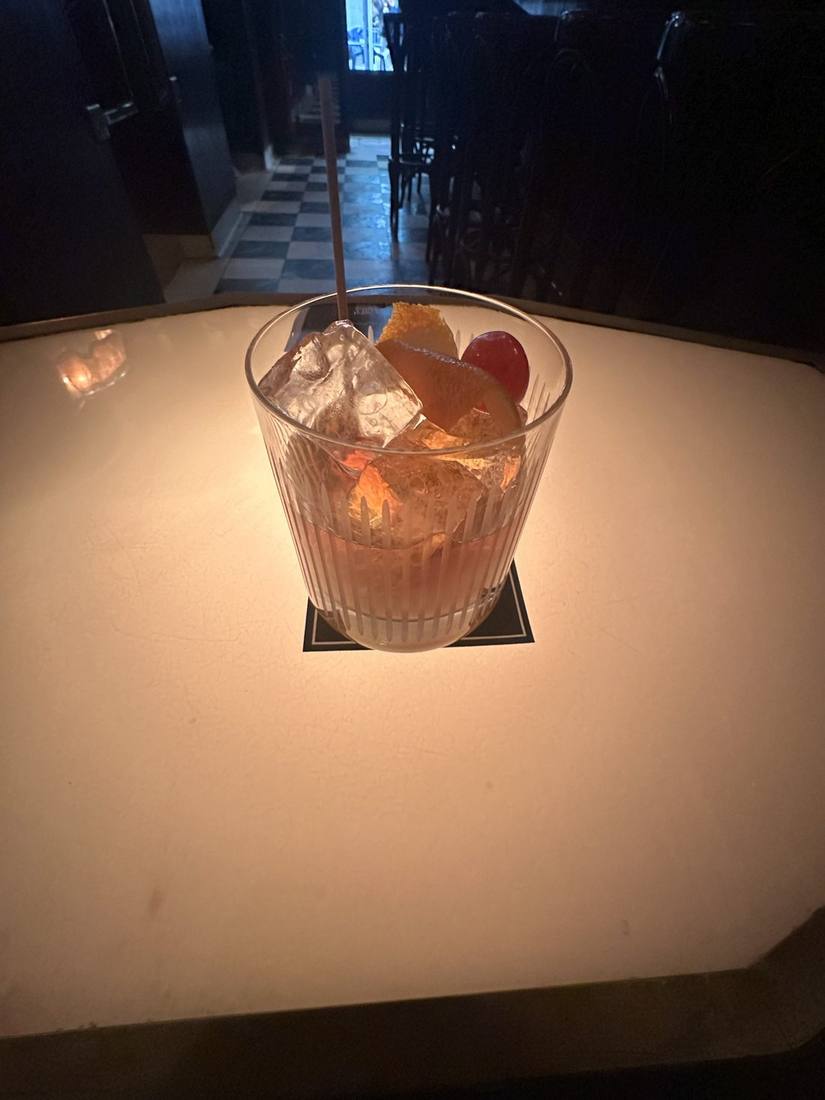
An Old Fashioned on the table. Ice cube the size of a Rubik's cube, orange peel and cherry. A monograph on Loos open in front of me — they leave them on the tables, so you sit in the room while reading about it.
Part II · The Overnight
The Sleeper
Coming back three weeks later for the longer version. Landing at 22:30 Sunday and not leaving till 22:05 Monday — nearly a full day on the ground. A hotel attached to the central station, sunrise in the imperial gardens before anyone else is up, then drifting through the city with no plan beyond catching the train back.
Premier Inn · Hauptbahnhof
The S7 from the airport hits Wien Hauptbahnhof in 25 minutes for less than a fiver. The Premier Inn is two minutes' walk from the concourse — same chain as London, same purple sign, but in Vienna. Bed by midnight. Quiet room. Station coffee at first light.
Belvedere Gardens
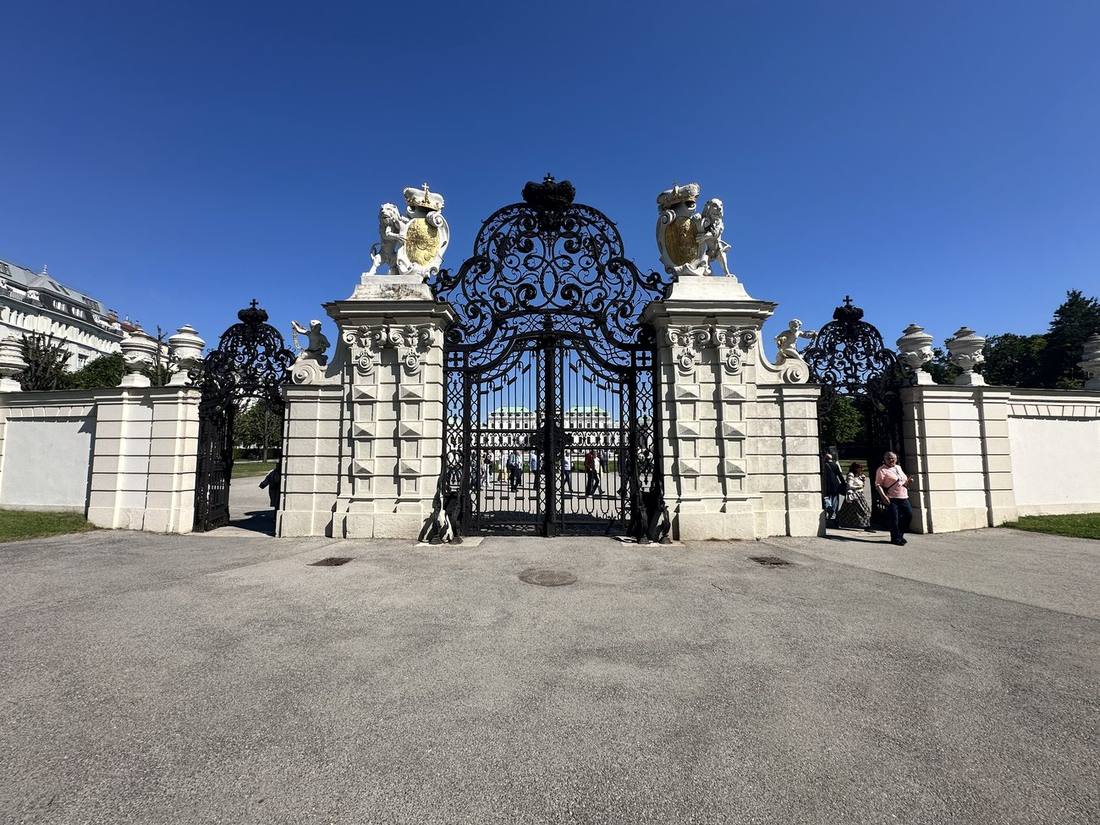
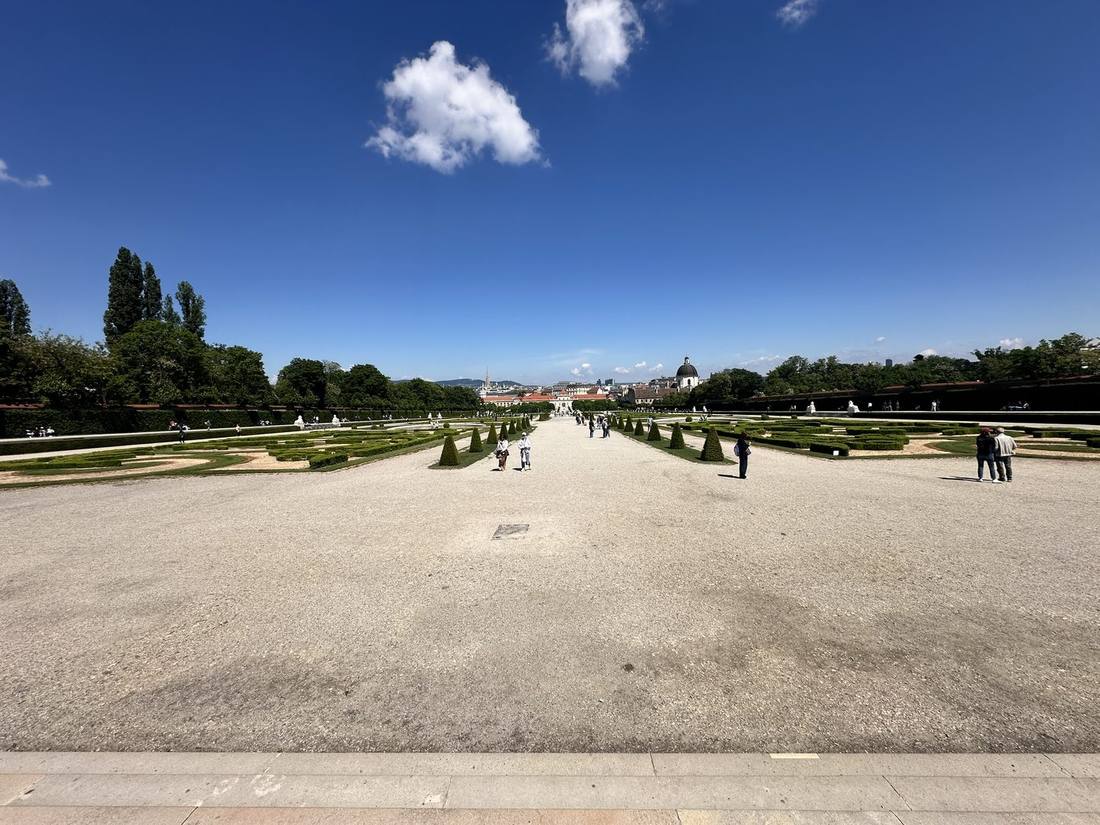
Walking up to Belvedere just after eight. The south gate first — wrought iron, crowned lions, gilded shields, very Habsburg — and then through into the gardens.
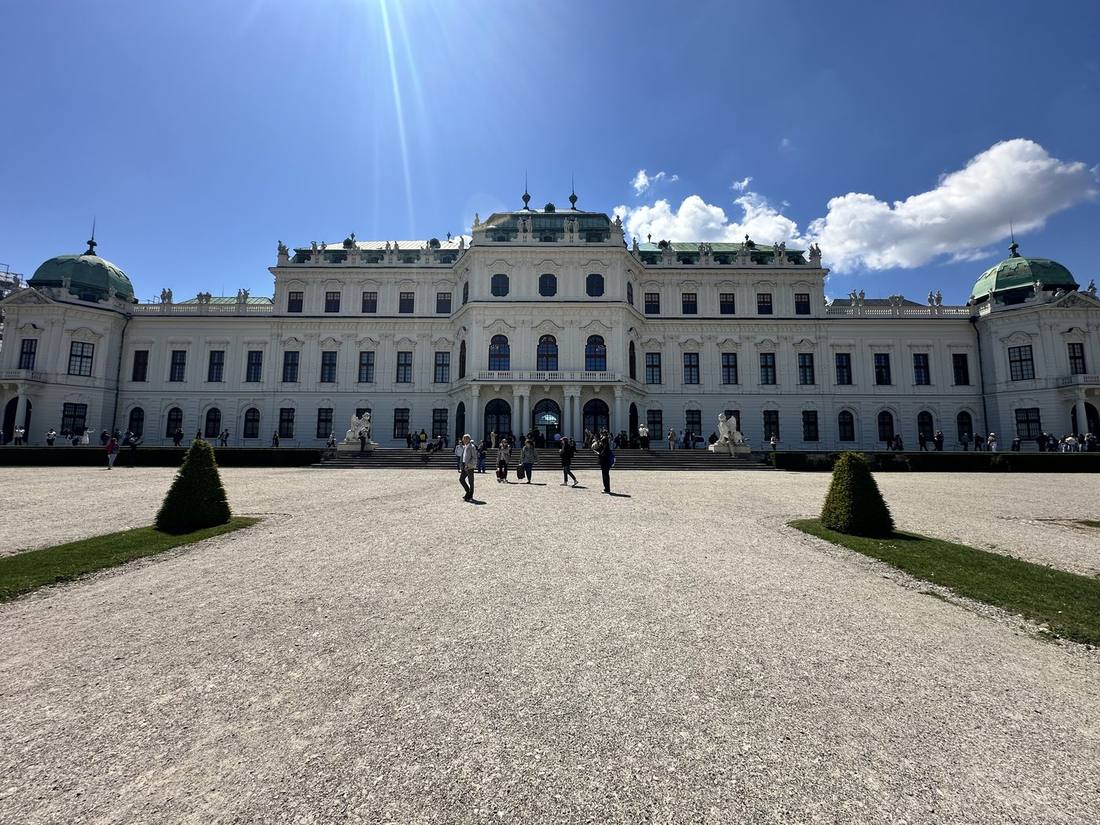
The trick with Belvedere is to walk all the way down the parterre first, then turn around. Hildebrandt designed the cascade and terraces in 1725 as one optical instrument; every gradient calibrated so the palace appears to float above its hill when viewed from below. Twenty metres of designed rise, every step tuned. The gardens to myself for half an hour before the first tour bus.
Premier Inn · Check-out
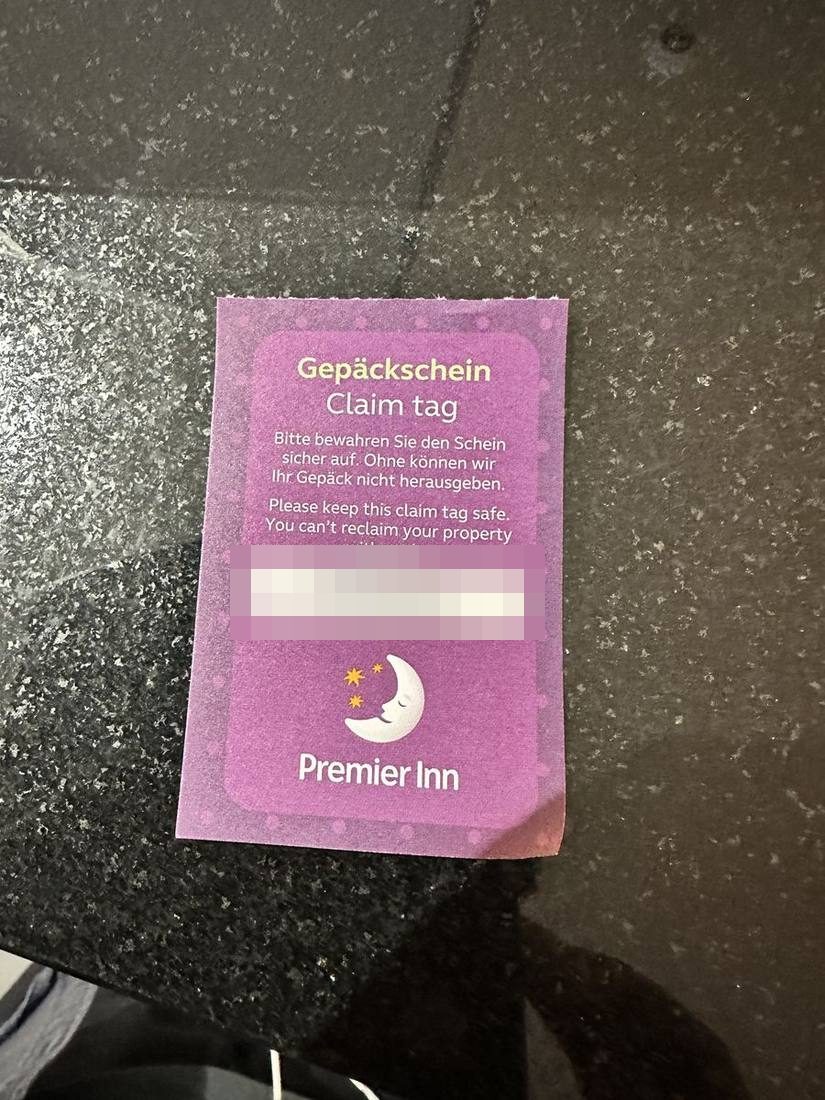
Back to the hotel by 11. Bag left at reception with a small lavender ticket — Gepäckschein [redacted]. The bag stays put until the train. The rest of the day is light.
Lime scooter · Into the city
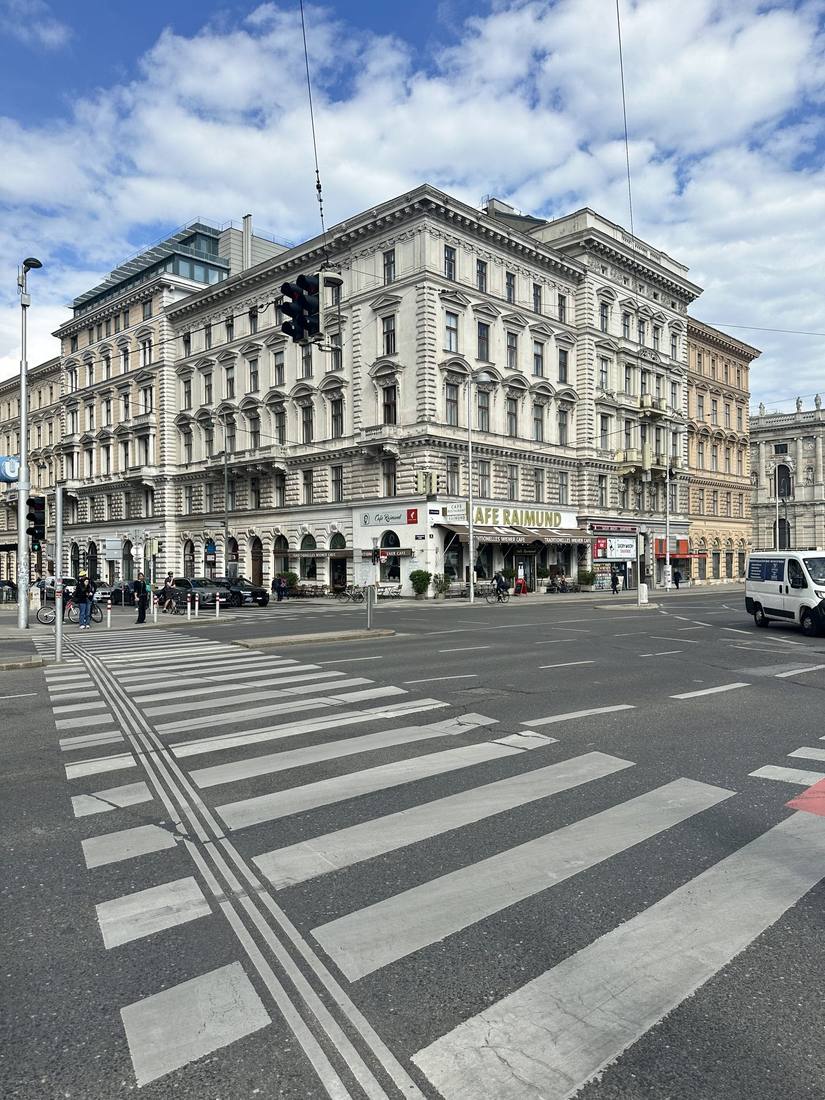
Unlocking a Lime scooter outside Hauptbahnhof and pointing it north. Vienna is one of the great cycling cities — wide protected lanes lining every Ringstrasse boulevard, smooth granite setts that the wheels barely feel. The whole inner city was rebuilt in the 1860s with Franz Joseph's vision of public space at its centre, and you feel that now, scooting past Belvedere's perimeter wall, through Schwarzenbergplatz, along the Ring with Parliament's white columns sliding past on the left.
Fifteen minutes door-to-door, wind in the face, the whole imperial quarter as your front yard.
Palace of Justice · Aula
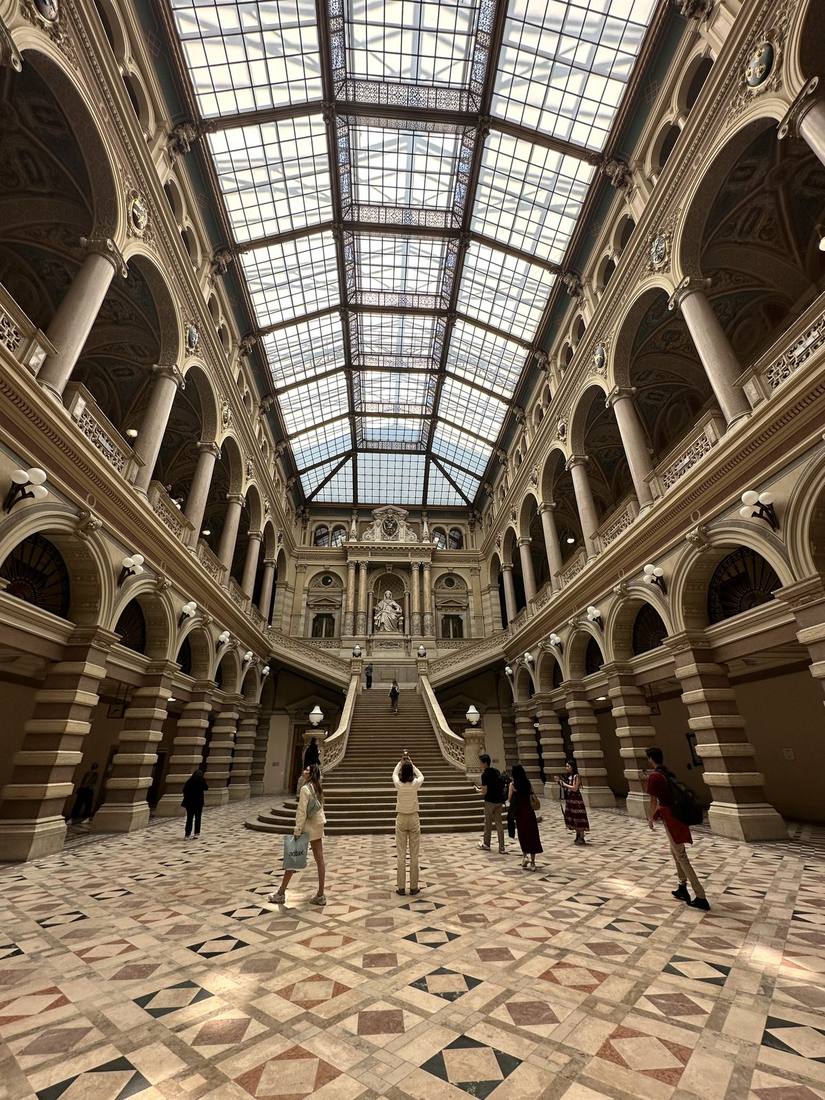
Through security at the Palace of Justice and into the Aula. Glass-and-iron barrel vault on stone arcades, marble staircase climbing to a statue of Justitia at the top. 1881 imperial engineering at imperial scale — the kind of room designed to make you straighten your back walking through it.
Then up to the fifth floor.
Justizcafé · The rooftop
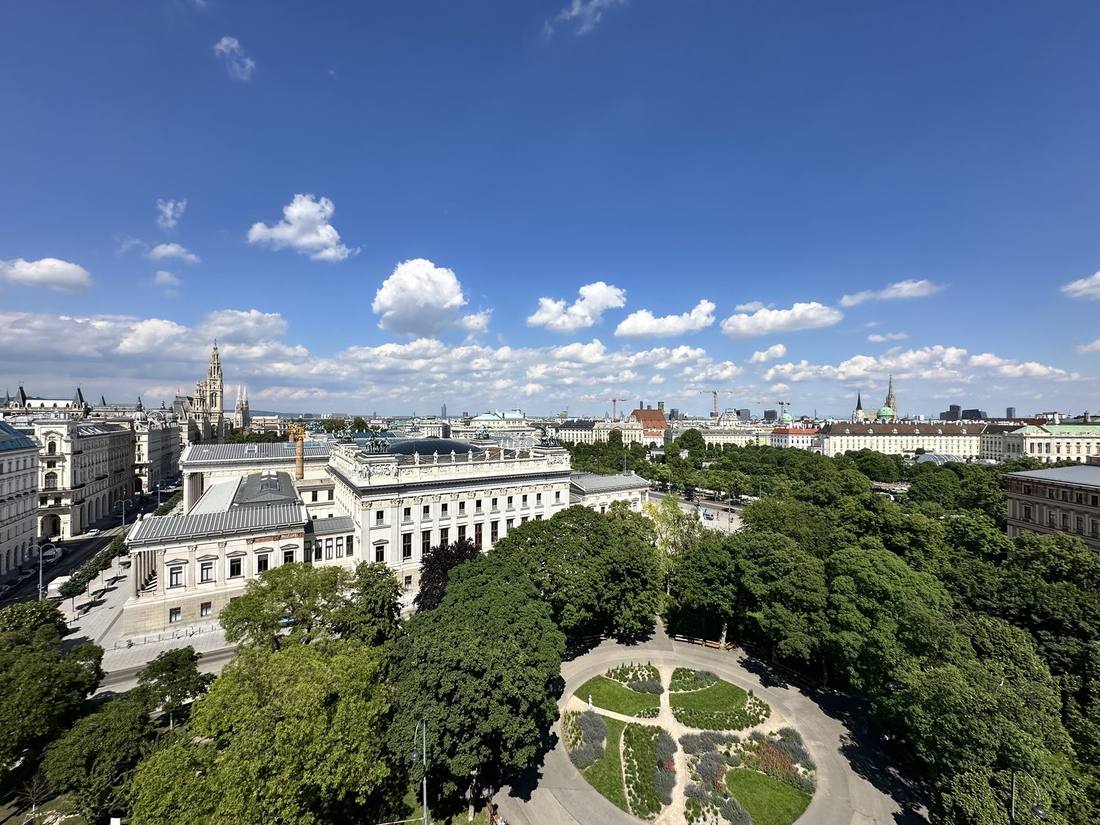
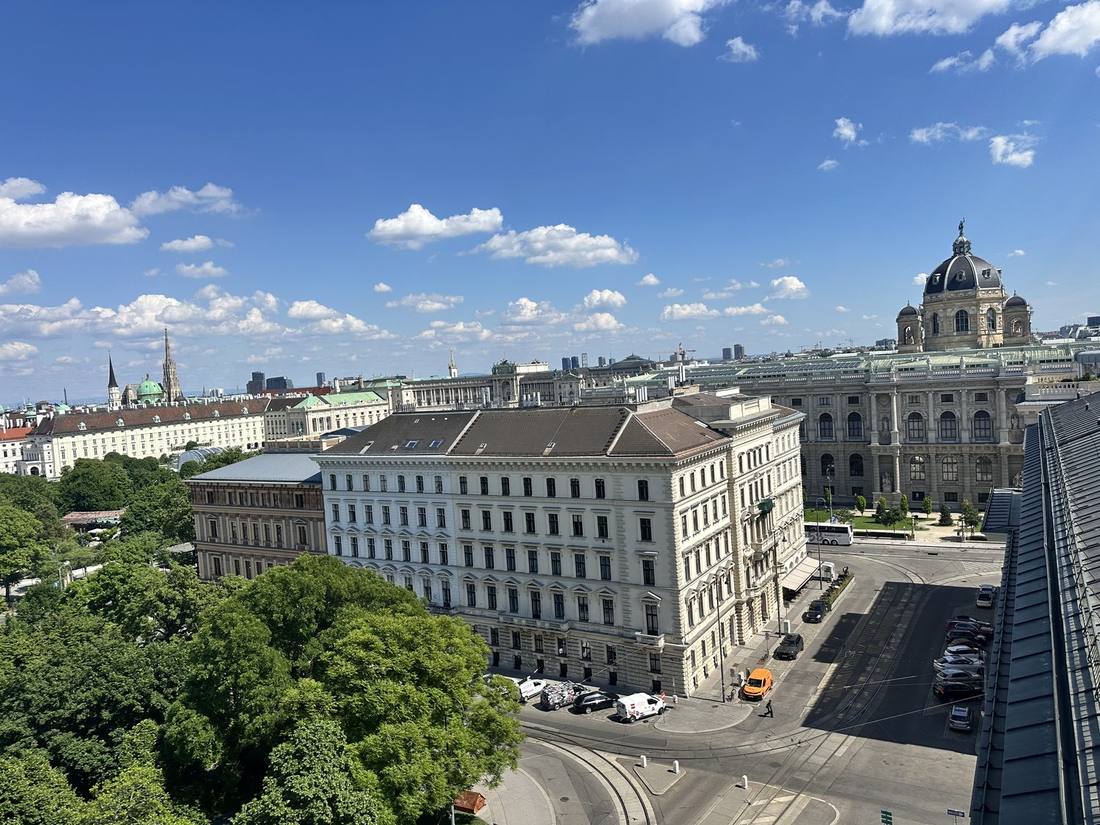
The fifth-floor terrace looks out over the Ring. Parliament directly opposite, the Rathaus's neo-Gothic spire to the left, the Hofburg complex spreading east toward Stephansdom, the Naturhistorisches and Kunsthistorisches museums framing the view to the right. No tourists know about this — it's a working canteen for the courts.
Standing at the railing and the whole 19th-century planning project of Vienna is laid out in front of you. The Ring was Franz Joseph's idea: tear down the medieval city walls, build a boulevard ring of public buildings around the old centre. From up here you can see the whole thing as one composition.
Burggarten · Schmetterlinghaus
Down through the Volksgarten — full rose bloom in May — and into Burggarten, the old imperial private garden. The Palmenhaus is 128 metres of wrought iron and glass, opened 1901, one of the largest of its kind in Europe.
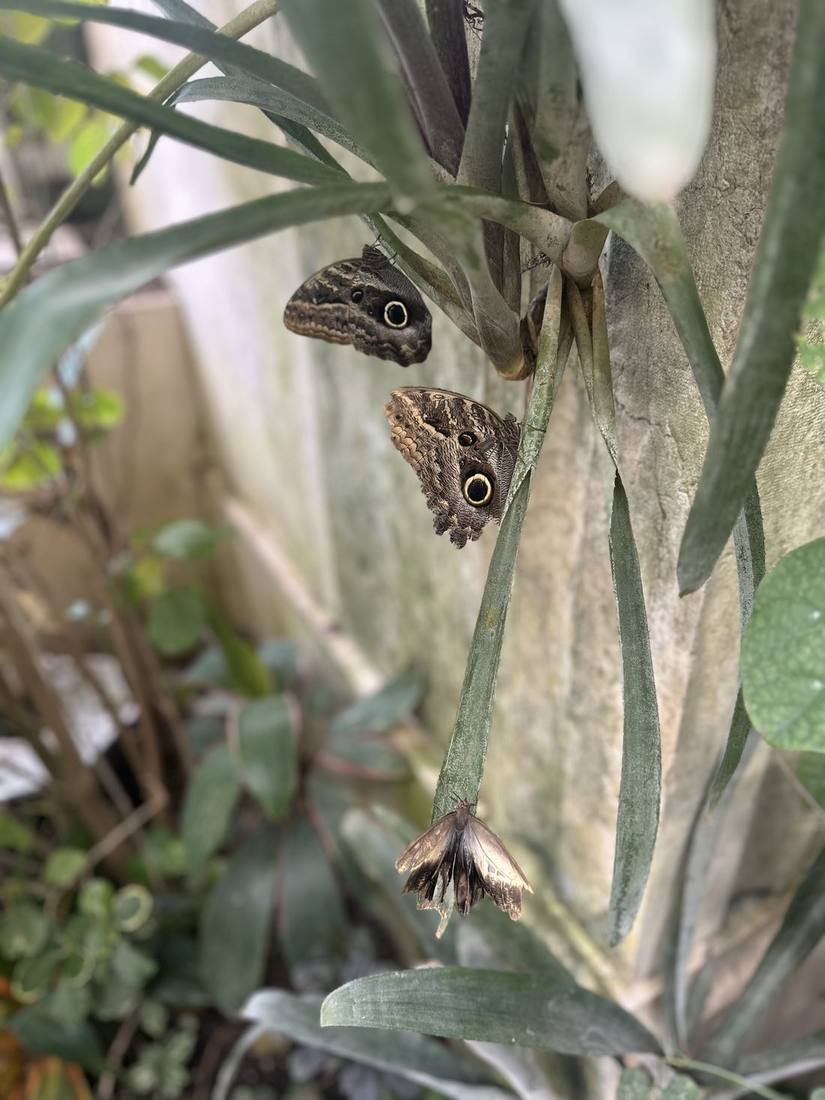
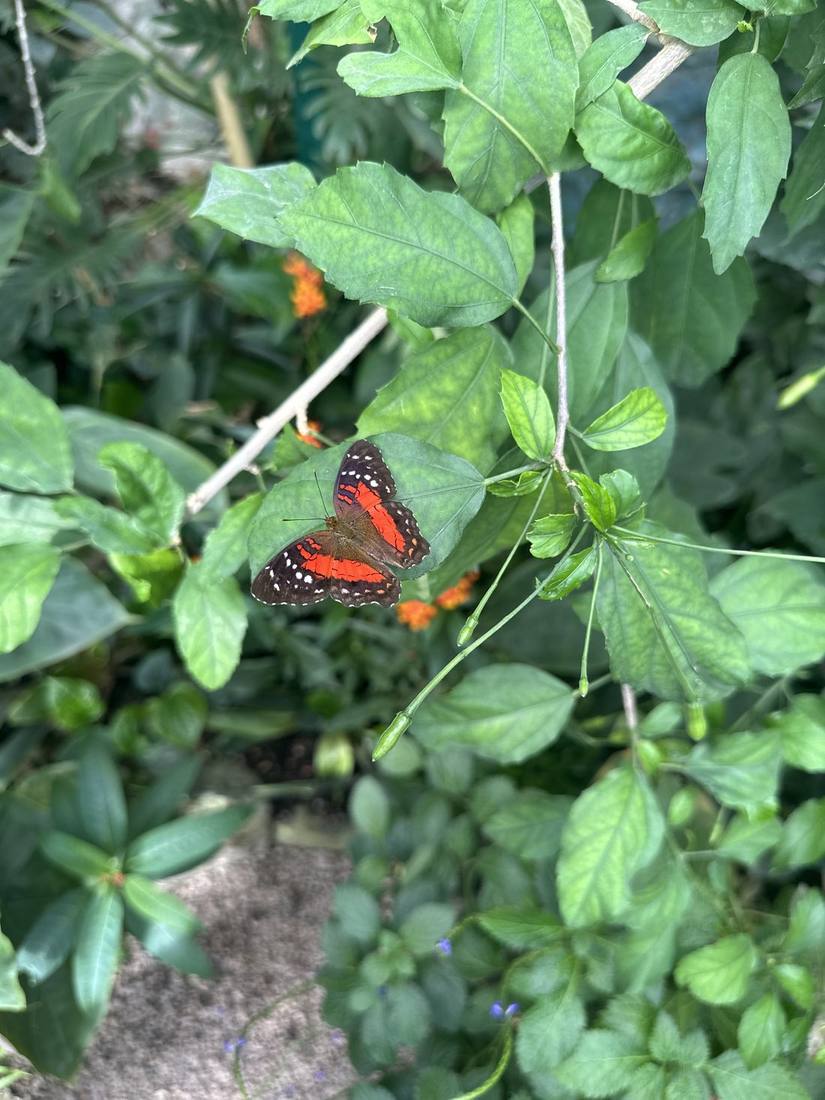
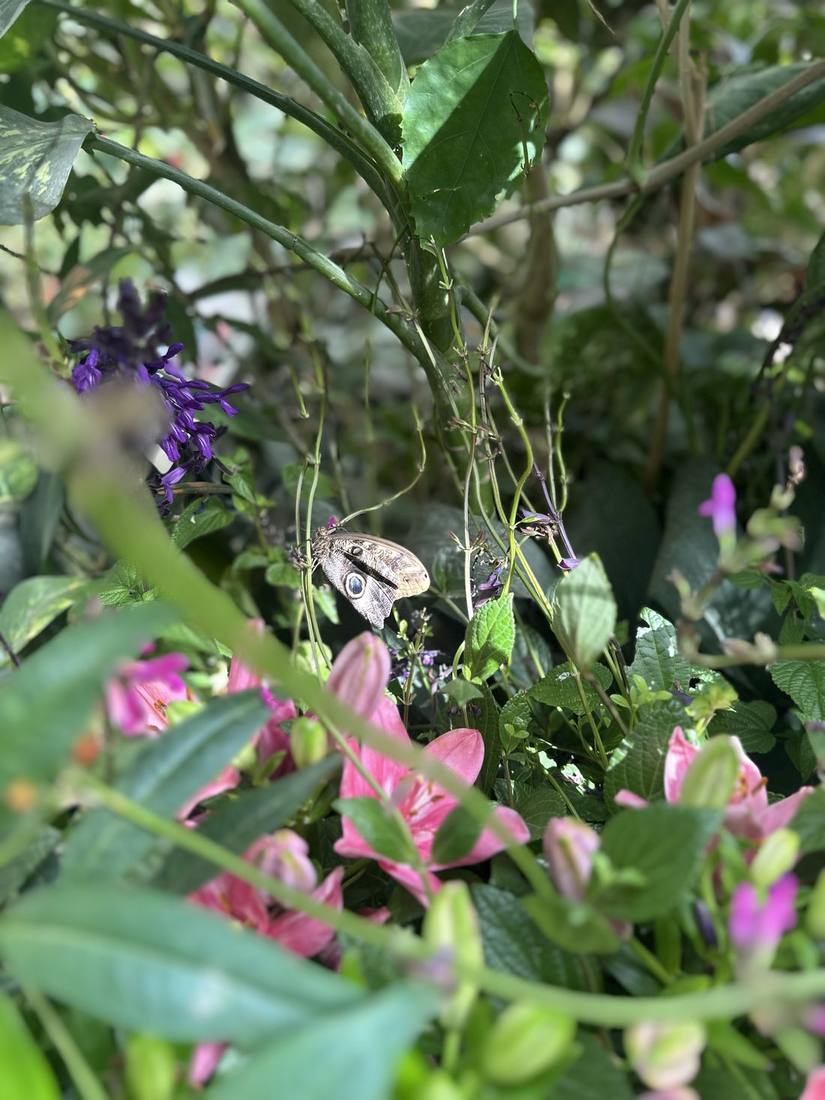
Tucked into one wing: the Schmetterlinghaus, the butterfly house. Inside it's tropical — humid air, 400 species, all free-flying. Owl butterflies hanging upside-down on bromeliads with their fake-eye markings; a scarlet peacock landing on a leaf two feet from my face. Stayed an hour without meaning to.
Albertinaplatz
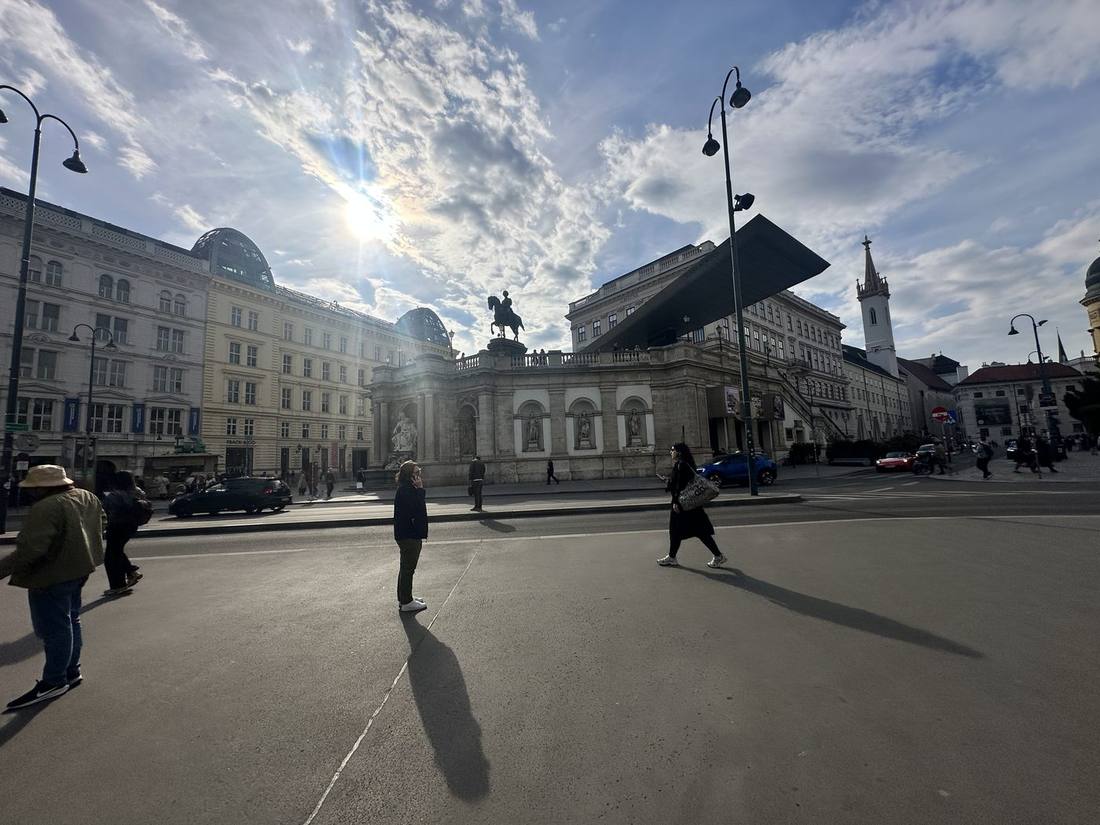
Walking through Hofburg into Albertinaplatz — and there it is, Hans Hollein's titanium Soravia Wing hovering above the baroque Albertina palace. 64 metres of cantilever, no visible support, finished 2003. Pure tension structure suspending itself against everything underneath it.
The equestrian Archduke Albert is in front, the white spire of Augustinerkirche behind, the State Opera through the next arch. The whole stage set of Vienna in one corner.
Bitzinger Würstelstand
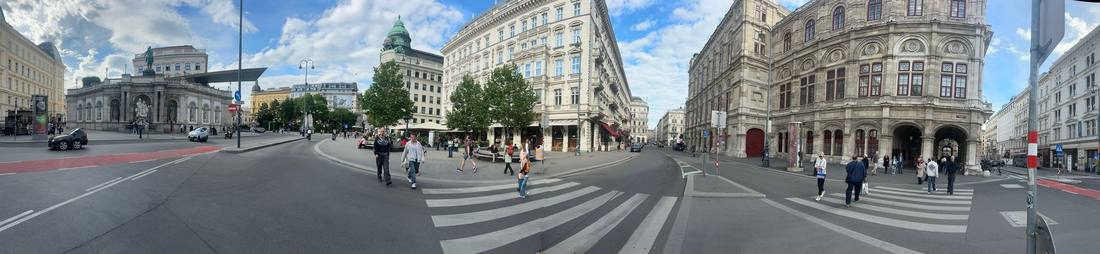
Pre-flight fuel at Bitzinger — a green-and-cream sausage cart tucked into the corner of Albertinaplatz, square in the shadow of the State Opera. Here since the 1940s, no architect's name attached, just a kiosk that's outlasted whole governments. Look closely at the previous photo — you can see it on the left, the little stall the size of a small car, holding its own against Hollein's titanium cantilever and the Opera's neo-Renaissance arcade.
Käsekrainer — cheese-stuffed bratwurst, the cheese melted through the pork so each bite has a hot pocket of it — with süßer Senf and a bottle of Ottakringer. Eaten standing at the chest-high counter. The crowd is everything: theatre performers in dark coats heading to evening rehearsals at the Staatsoper, lawyers off duty, taxi drivers, tourists who lucked into it. All scoffing down a Wurst and a beer in the same three-minute ritual. The best closing meal in the city — and the most democratic.
Lime back · Railjet to VIE
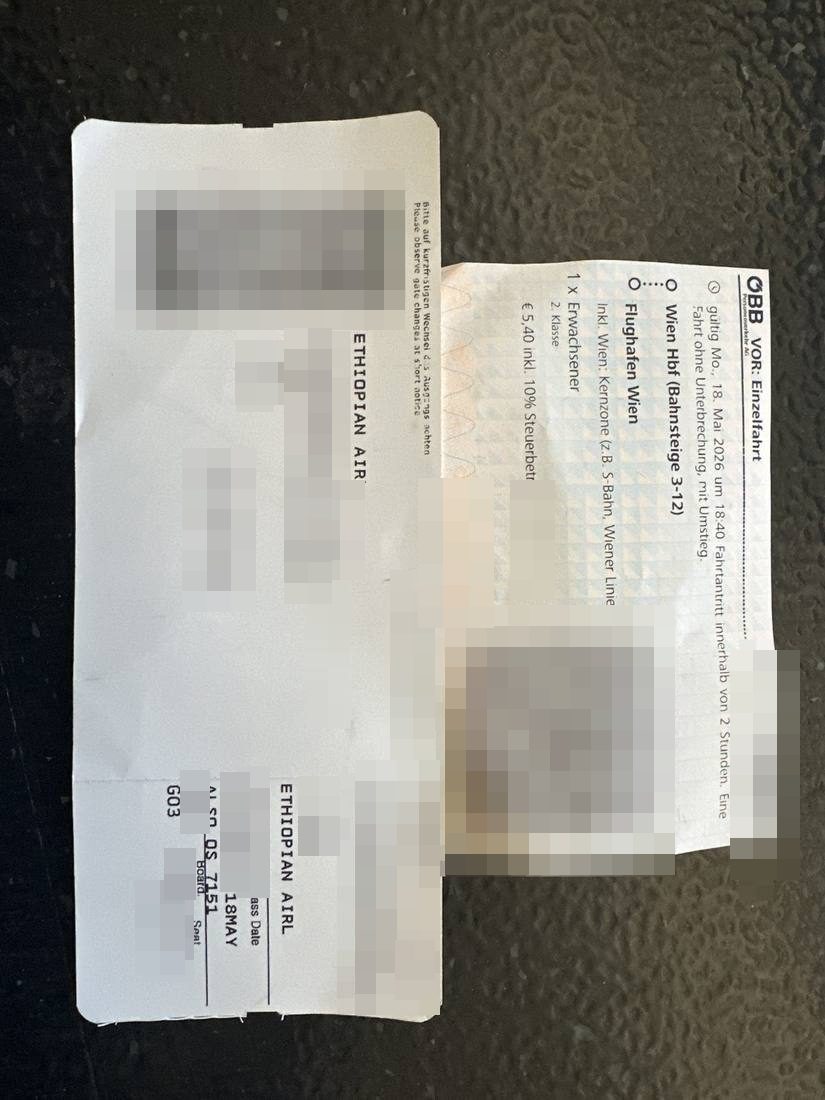
Lime scooter back to Premier Inn the same way I came — south down the Ring, past the front of Belvedere again, the golden hour catching the upper façade. Bag collected (claim number redacted). Platform 3. ÖBB Railjet to Flughafen Wien at 18:40. Then boarding pass for OS 7151 / ET 0725, with personal boarding details redacted.
22:05 wheels up. Vienna behind, Addis ahead. Somewhere over the Balkans this memoir gets written.
The Long Arc
Stephansdom foundations (1147) · Franciscans arrive (1224) · Franziskanerkirche (1603) · Dominikanerkirche (1631) ·
Pozzo’s illusions (1703–07) · Belvedere (1725) · Justizpalast (1881) ·
Palmenhaus (1901) · Loos Bar (1908) · Hollein Canopy (2003).
856 years from first stones to last titanium.
Part III · When I Return
Two layovers covered Vienna's spine but not its full geometry. The list below is what got left on the table — saved deliberately, shut on a Monday, or simply waiting for more than half a day.
- KarlskircheFischer von Erlach's 1737 baroque dome flanked by twin Trajan-style columns. The panoramic lift takes you inside the shell — engineering and frescoes at the same eye level.
- Stephansdom · South Tower climb343 steps inside the Steffl. The interior was glimpsed externally on the first trip; the ascent is for next time.
- Otto Wagner Postsparkasse1906. Aluminium-bolted marble façade, glass-floored banking hall hung from a steel frame. Engineering-as-architecture made literal.
- Otto Wagner Stadtbahn PavilionsKarlsplatz, 1899. Pre-fabricated cast-iron frame, marble panels bolted on. Public infrastructure as Jugendstil manifesto.
- Secession Building · Beethoven FriezeClosed Monday on Part II. Klimt's 1902 frieze in the basement — the Gesamtkunstwerk in plaster and gold leaf.
- Albertina · Habsburg State RoomsEmpire mirrors, parquet, the Audience Chamber. Walked under the cantilever twice without going inside.
- Kunsthistorisches Museum · Cupola Hall CaféArguably the most beautiful café room in Europe. Coffee under the dome, no museum ticket required.
- SchottenstiftIrish Benedictine abbey founded 1155 — the "Scottish Abbey," because medieval Germans called Ireland Scotia. Romanesque foundations under baroque skin.
- Hundertwasserhaus & KunstHausWien1985. The anti-grid social-housing experiment. Undulating floors, planted roofs, no two windows alike.
- Schönbrunn · Palace & GardensThe Habsburg summer residence at full scale. Needs a half-day minimum; never fits a layover.
- Café Sperl · Central · LandtmannThe three classic Kaffeehäuser still unticked. Sperl for Schiele's ghost, Central for Trotsky's, Landtmann for Freud's.
- Das Loft · Sunset coffeeJean Nouvel's tower with Pipilotti Rist's backlit rainbow ceiling. The architectural payoff of contemporary Vienna.
- Musikverein or State Opera · A concertThe Goldener Saal has the best acoustics on Earth (debatably). Standing-room tickets from €3.
- Heuriger night · Vienna WoodsThe wine taverns of Grinzing and Nussdorf — Sturm in autumn, Grüner Veltliner in summer. Vienna's hinterland.